Often mass planted under trees and in cottage gardens, Bluebells are one of the easiest spring bulbs to grow next to daffodils and add a brilliant touch of blue to any garden setting.
Planting Calendar
Bluebells are best planted in Autumn to ensure flowering in Spring.
Prepare
Position
Bluebells are best planted in full sun to part shade and are perfect when planted under deciduous trees. However, they give a better impact when grown in the ground rather than in pots, allowing them to naturalise and multiply over the years.
Soil
When planted into the ground, Bluebells like a free draining soil that is rich in organic matter. To improve the organic content in your soil fork over then add Kings Compost, Kings Sheep Pellets and mix together well. When grown in containers, plant into Kings Potting Mix.
Plant
The general rule is to plant at a depth of twice the diameter of the bulb. However in heavier soils, plant slightly closer to the surface. Fork up the soil up to 15 cm depth and add Kings Bulb Food. Plant with the pointy side facing upwards, at a depth of 10cm and at least 10cm apart as they will bulk up over time. In heavier clay soils, where drainage is likely to be an issue, plant onto a raised mound and sprinkle Gypsum Clay Breaker into the bottom of the hole, this helps slowly condition the soil and help to break down the clay.
Care
Tip
Apart from the blue, bluebells also come in white, pink and light blue flowering varieties too. They make excellent cut flowers for vases and floral displays.
Top Varieties
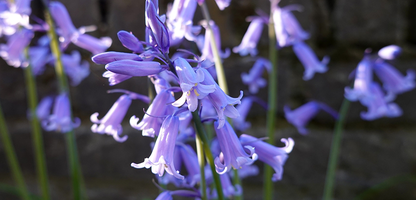
Spanish bluebells
Taller, 30-45 cm in height and produce flowers all around the stalk. Flowers are not as fragrant as the English bluebells and bloom a bit later. Better grown in open spaces.
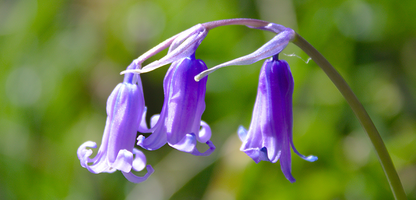
English bluebells
Shorter, 25-30 cm tall with fragrant early flowers that are produced on only one side of the stalk, causing them to tilt to one side.
Frequently Asked Questions
How deep should I plant bluebell bulbs?
Plant bluebell bulbs about 10cm deep and 10cm apart
Do bluebells require much water?
Once the bulbs have started to sprout water gently, so that the soil is kept just moist.
How long do bluebells take to flower?
Bluebells typically flower in spring, around mid-September to October in Auckland.
Are bluebells toxic to pets?
Bluebells are toxic to cats and dogs if ingested, so keep pets away from them.
Do bluebells spread easily?
Bluebells can spread quite easily by self-seeding and naturalising, creating lovely drifts over time.